
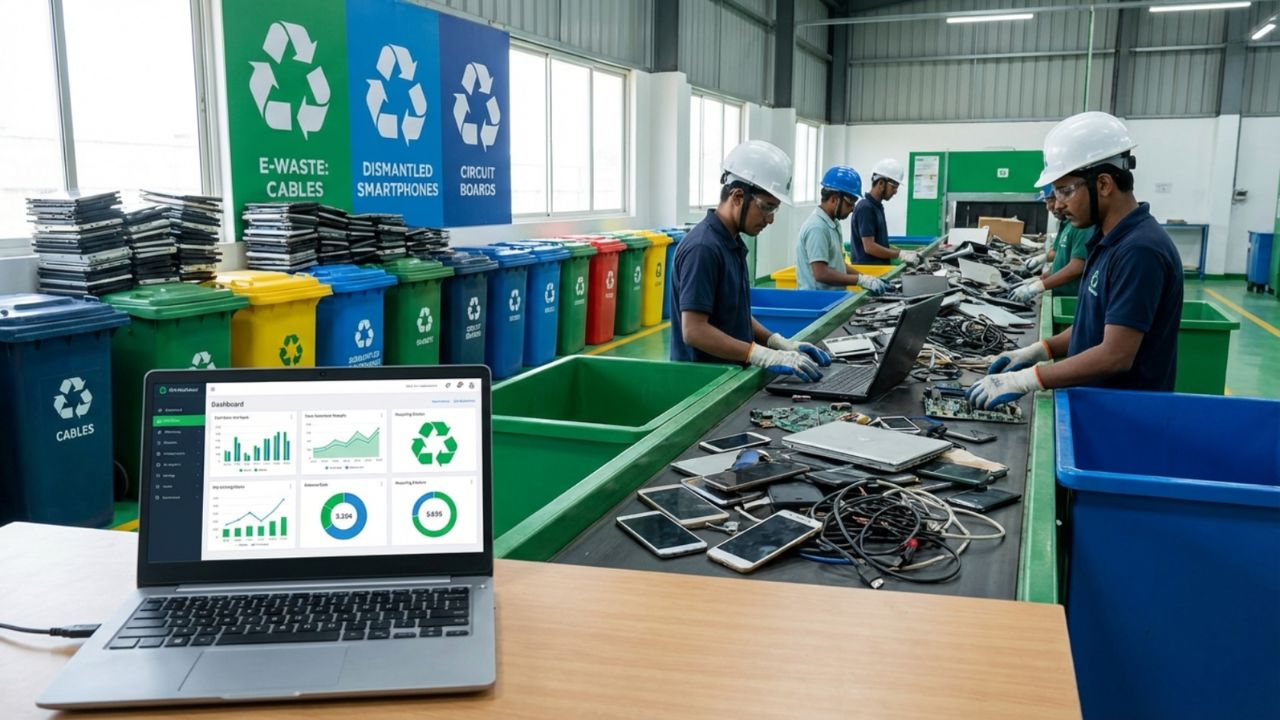
India’s use of electronic products has increased rapidly over the years. Mobile phones, laptops, televisions, networking equipment, and household electronics are now part of daily life across homes, offices, schools, and industries. As the number of devices in use grows, the country also faces a rising challenge in managing discarded electronics in a safe and organized way.
Electronic waste, or e-waste, cannot be treated like ordinary household waste. It contains both valuable recoverable materials and hazardous substances that require proper handling. To improve accountability in this area, India introduced the E-Waste (Management) Rules, 2022, which placed a stronger compliance burden on producers, recyclers, manufacturers, and refurbishers. A major part of this system is the EPR Portal for E-Waste Management, operated by the Central Pollution Control Board (CPCB).

The portal is designed not only for registration but also for monitoring how e-waste is procured, recycled, certified, and counted toward compliance obligations. In practical terms, it acts as a digital tracking system that connects producers, recyclers, uploaded invoices, recycling quantities, and EPR certificates within one regulated framework.
Table of Contents
What the EPR Portal Is Meant to Track
The EPR Portal was created to bring e-waste compliance into a digital and traceable system. Under this framework, registered stakeholders use the portal to submit information, upload records, and maintain a digital trail of their activities. CPCB states that the portal regulates registration certificates and EPR obligations for entities covered under the e-waste rules.
Its tracking function is especially important because recycling claims cannot simply be accepted on verbal declarations. The system is built to capture data on the quantity of e-waste procured, the amount processed, the end products recovered, and the sale of those end products by registered recyclers. Based on this uploaded information, CPCB generates EPR certificates through the portal.

This makes the portal more than a registration website. It is effectively a compliance ledger that records the flow of regulated e-waste and links that flow to the legal obligations of producers.
How Registered Recyclers Enter Recycling Data
The tracking process begins with registered recyclers. CPCB’s guidance says recyclers must upload details of the quantity of e-waste procured or collected, recycled, and the end products produced and sold on the E-Waste EPR Portal. These details are supported by invoices and related records.
The portal expects data to be entered in a sequence. Recyclers first provide procurement details and upload corresponding invoices. After that, they enter production details showing the end products obtained from the recycled e-waste. They then upload GST-linked sales invoices for those end products before moving to certificate generation. CPCB’s guidance specifically describes this step flow for recyclers.

This structured sequence helps reduce arbitrary or unsupported claims. Because the system requires procurement records, production data, and sales records, the portal creates a linked chain of evidence rather than allowing isolated entries.
Role of Invoices and Procurement Proof in Tracking
A major strength of the portal is that it relies on documentary proof instead of broad estimates. CPCB’s FAQ states that where e-waste is purchased from the formal sector, the recycler must upload the seller’s sales invoice. Where e-waste is purchased from the informal sector, the recycler must upload a sales receipt containing the seller’s name and address.
This requirement matters because e-waste often moves through multiple hands before reaching a recycling unit. By requiring purchase proof, the portal creates traceability at the point where waste enters the formal recycling chain. It also helps authorities review whether the recycler’s procurement claims are supported by records.
In addition, CPCB’s guidance notes that sequence of procurement dates and sales dates must be maintained, and that recyclers should ensure correctness of uploaded data related to procurement, recycling, and sale of end products.
How the Portal Converts Recycling Into EPR Certificates
One of the most important tracking functions of the portal is the generation of EPR certificates. CPCB’s guidance states that the Central Pollution Control Board generates EPR certificates through the portal in favor of registered recyclers, and the quantity eligible for certificate generation is based on the quantity of e-waste recycled by them.
The system does not stop at recording raw recycling activity. It translates verified recycling data into certificates that producers can purchase to fulfill their annual EPR obligations. CPCB explains that producers are required to meet annual obligations through purchase of EPR certificates from registered recyclers, while the certificates themselves are generated by CPCB through the portal based on recycling carried out by those recyclers.
This is the core compliance bridge in the portal. Recyclers provide the recycling proof, CPCB generates digital certificates, and producers use those certificates to demonstrate fulfillment of their legal obligations. Because this process takes place within the same portal, tracking becomes much more transparent.
How Producers Are Tracked Against Their Obligations
The portal is also used to track producers, not just recyclers. Producers place electrical and electronic equipment in the market, and under the rules they carry annual EPR obligations. These obligations are fulfilled by purchasing EPR certificates generated in favor of registered recyclers.
CPCB’s guidance further states that the details provided by the producer and the registered recycler are cross-checked on the portal. If there is any difference between the two, the lower figure is considered toward fulfillment of the producer’s EPR obligation.
That cross-checking mechanism is a key part of digital monitoring. It prevents the same recycling quantity from being overstated and ensures that the final compliance count is based on the more conservative matched figure where discrepancies appear.
Cross-Verification, Audit, and Monitoring Controls
The EPR Portal does not work on self-reporting alone. CPCB’s guidance says EPR certificates generated through the portal are subject to environmental audit by CPCB or agencies authorized by CPCB. It also states that SPCBs and PCCs are required to periodically verify recyclers’ facilities, machinery, capacity, documents, invoices, and the information uploaded on the portal.
This means the portal combines digital filing with physical or operational verification. A recycler may upload data online, but that data can still be checked against installed machinery, plant capacity, storage area, records, geo-tagged images, and operational capability.
Such monitoring helps ensure that certificate generation reflects genuine recycling activity. It also strengthens the credibility of the compliance system, which is important in a sector where unsupported waste claims can distort environmental performance.
Why the Portal Improves Transparency in E-Waste Recycling
Before a centralized system, recycling compliance could be harder to verify because records were often fragmented across different entities. The EPR Portal creates a common digital platform where registration, procurement details, recycling data, end-product sales, and certificate generation are all connected.
This improves transparency in several ways. First, it reduces reliance on offline claims. Second, it provides a traceable sequence of transactions. Third, it allows regulators to compare data submitted by different stakeholders. Fourth, it creates a documented basis for certificate issuance and compliance review. CPCB’s own guidance reflects this model by requiring sequential invoice upload, end-product sales records, and cross-checking of producer and recycler data.
The portal also improves accountability because data editing becomes restricted after submission in certain contexts. CPCB’s FAQ notes that after submission, there is no editing option in the migrated system context discussed there, showing that the portal is designed to preserve integrity of submitted information.
Common Compliance Limits Built Into the System
The portal’s tracking design includes practical checks that support cleaner data entry. CPCB’s guidance tells recyclers not to procure e-waste in a year beyond their total annual processing capacity. It also requires them to maintain records of e-waste procured, processed, and end products sold, and to make records available for verification or audit when required.
CPCB also states that if a recycler does not have the facility to recycle all materials, the unrecycled fractions should be sent to another registered recycler or an authorized treatment, storage, and disposal facility, with data maintained accordingly.
These controls matter because they connect data entry to real operational capability. The portal is not meant to be a paper exercise. Its design is intended to ensure that recycling quantities claimed online are consistent with plant capacity, procurement records, and downstream material handling.