
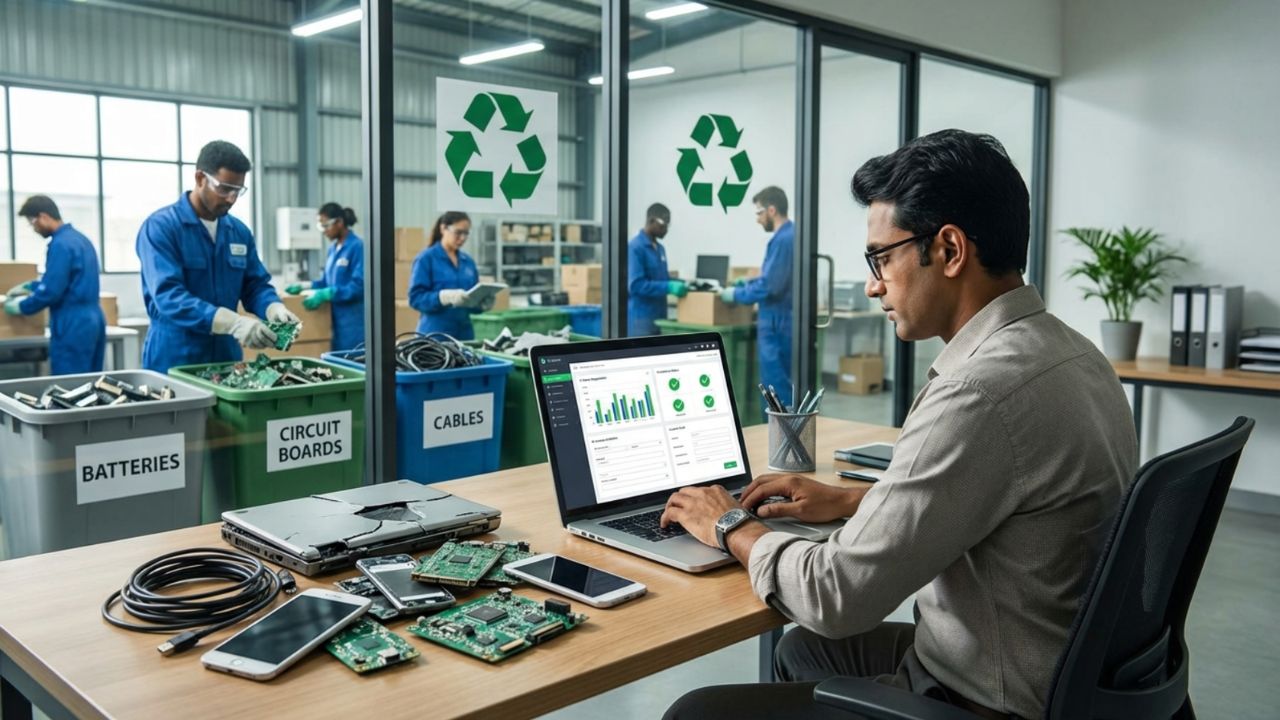
India’s electronics market has expanded quickly over the last decade. From mobile phones and laptops to televisions, batteries, and household appliances, electrical and electronic equipment now forms a major part of daily life. As the use of these products increases, the amount of discarded equipment also rises, making e-waste management an important environmental and regulatory issue.
To address this challenge, India introduced a formal compliance framework under the E-Waste (Management) Rules, 2022. A key part of this system is the EPR Portal for E-Waste Management, operated by the Central Pollution Control Board (CPCB). The portal is used for registration, compliance tracking, and monitoring of producers, manufacturers, recyclers, and refurbishers dealing with electrical and electronic equipment listed in Schedule I of the rules.

For businesses that fall under these rules, registration is not just an administrative formality. It is the foundation for lawful participation in India’s e-waste compliance system. The portal also helps authorities verify obligations, issue registration, and track recycling-related performance through a centralized digital mechanism.
Table of Contents
What EPR Registration Means in the E-Waste System
EPR stands for Extended Producer Responsibility. In simple terms, it means that the producer of electrical and electronic equipment remains responsible for the environmentally sound management of waste arising from those products after they enter the market.
Under the current rules, registration on the CPCB portal is required for the main regulated stakeholders covered under the e-waste framework. CPCB’s FAQ states that registration is issued to producers, recyclers, refurbishers, and manufacturers of electrical and electronic equipment listed in Schedule I of the rules.

This registration creates a formal digital identity for the applicant in the compliance system. Once approved, the entity can carry out activities that fall within its registered category, submit required information through the portal, and participate in the regulated e-waste chain. CPCB’s manufacturer SOP also makes clear that no entity should carry out such business without registration, and registered entities should not deal with unregistered manufacturers, producers, recyclers, or refurbishers.
Who Can Apply for Registration
Before beginning the process, a business must first identify the correct category under which it needs to apply. This is important because the portal and supporting documents differ depending on the applicant’s role.
According to CPCB’s FAQ, a producer includes a person or entity that manufactures and sells electrical and electronic equipment under its own brand, sells assembled products under its own brand, offers imported electronic equipment under its own brand, or imports used electrical and electronic equipment. A manufacturer is an entity with facilities for manufacturing electrical and electronic equipment listed in Schedule I. A refurbisher is an entity repairing or assembling used equipment to extend its working life for the same intended use, and a recycler is an entity engaged in recycling and reprocessing e-waste for recovery of useful materials.

In practical terms, businesses should not apply casually under a broad label. The right category should match the actual business activity. If an entity performs more than one regulated role, CPCB’s SOP indicates that it may need separate registration under those categories.
Step 1: Confirm That the Products Fall Under Schedule I
The first step is to confirm that the equipment being manufactured, sold, imported, refurbished, or recycled is actually covered by the e-waste rules. CPCB’s FAQ states that EPR registration applies to electrical and electronic equipment, including their components, consumables, parts, and spares that make the product operational, as listed in Schedule I of the E-Waste (Management) Rules, 2022.
This is a critical starting point because registration obligations are linked to covered product categories. If the products do not fall within the listed categories, the entity may not belong within this specific EPR registration process. If they do, the business should move ahead with the portal-based application.
For blog readers and first-time applicants, this step is often overlooked. Many registration issues begin not with the portal itself, but with a mismatch between business activity and the category of product covered under the rules.
Step 2: Identify the Correct Stakeholder Category
After confirming product coverage, the applicant should determine whether it is registering as a producer, manufacturer, recycler, or refurbisher. This matters because CPCB provides separate standard operating procedures and category-specific requirements for these stakeholders.
For example, producers are linked mainly with EPR obligations and recycling targets. Recyclers are linked with processing of e-waste and generation of recycling certificates. Refurbishers are connected with extending product life before items become waste. Manufacturers are associated with manufacturing facilities and applicable approvals.
A correct category selection at the beginning makes the later steps much easier. It also helps avoid rejection, rework, or the need for amendments soon after registration.
Step 3: Gather the Required Business and Regulatory Documents
The portal process is digital, but it still depends heavily on supporting documents. CPCB states that its SOPs explain the information and documents required for registration applications and also define timelines for processing.
For producers, the document set typically relates to the legal identity of the business and product-related details. For manufacturers, recyclers, and refurbishers, additional regulatory clearances are important. CPCB’s FAQ specifically states that recyclers should have a valid Consent to Operate (CTO) under the Air and Water Acts along with authorization under the Hazardous and Other Waste (Management & Transboundary Movement) Rules, 2016 from the concerned SPCB. It also states that manufacturers should have valid CTO for Green, Orange, and Red category industries, while white category industries are exempt from the CTO requirement. Refurbishers are also expected to hold valid CTO and authorization under the hazardous waste framework from the concerned SPCB.
The exact file list can vary by category, so applicants should treat document preparation as a serious compliance step rather than a routine upload exercise.
Step 4: Create an Account and Fill the Online Application
Once the category and documents are ready, the next step is to access the CPCB e-waste EPR portal and create the stakeholder account. The registration process is intended to be completed through the centralized portal, where the applicant enters business details, category information, and other required declarations. CPCB’s public portal describes it as the platform through which registration certificates and EPR obligations are regulated.
During this stage, the applicant must ensure that business identity details are consistent across all records. Name, address, legal status, and category-related information should match the uploaded documents. Even minor inconsistencies can delay processing.
Applicants should also review the entered product or activity details carefully before final submission. A digital form may appear simple, but it becomes the official compliance record once filed.
Step 5: Pay the Applicable Registration Fee
Registration on the portal is linked to applicable fees. CPCB’s FAQ includes a fee structure for producers and also separately lists charges for recyclers, refurbishers, and manufacturers. For producers, the processing fee depends on the annual e-waste recycling target slab. For recyclers, the FAQ notes a proposed fee of ₹15,000 for first-time registration valid for five years, with separate renewal charges later.
A simple overview is given below.
| Stakeholder Type | Fee Approach Mentioned by CPCB |
|---|---|
| Producer | Based on annual e-waste recycling target slab |
| Recycler | New registration fee listed separately; validity linked to five years |
| Refurbisher | Category-specific registration and maintenance charges apply |
| Manufacturer | Category-specific registration and maintenance charges apply |
Because fee structures can be updated through official notifications or portal revisions, applicants should always verify the live fee shown during filing before making payment.
Step 6: Wait for Scrutiny, Clarification, and Approval
After submission, the application is reviewed according to CPCB’s SOP-based process. CPCB’s FAQ states that the SOPs define the information to be submitted and the timelines involved in grant of registration.
If the authority finds missing documents, incorrect information, or category mismatches, it may seek clarification or require correction. This stage is important because approval is based not only on filing the form, but on whether the application is complete and aligned with the rules.
Once approved, the entity receives registration on the portal and can proceed with category-specific compliance activities. For producers, that later includes EPR obligations and recycling target-related actions. For recyclers and refurbishers, it supports lawful movement and processing of e-waste within the regulated system.
Step 7: Keep the Registration Updated After Approval
Registration is not the end of compliance. Businesses must keep their portal records updated when there are changes. CPCB’s FAQ explains that for addition of EEE items in an existing producer registration, the user should go to the Amendment section, create an amendment, and select the addition of EEEs. It also explains that for a company name or address change, the producer should use the amendment section and upload revised records such as GST and IEC documents wherever applicable.
This shows that the portal is designed not just for first-time registration but also for ongoing compliance maintenance. Businesses should therefore treat the portal as a living compliance account rather than a one-time filing window.