
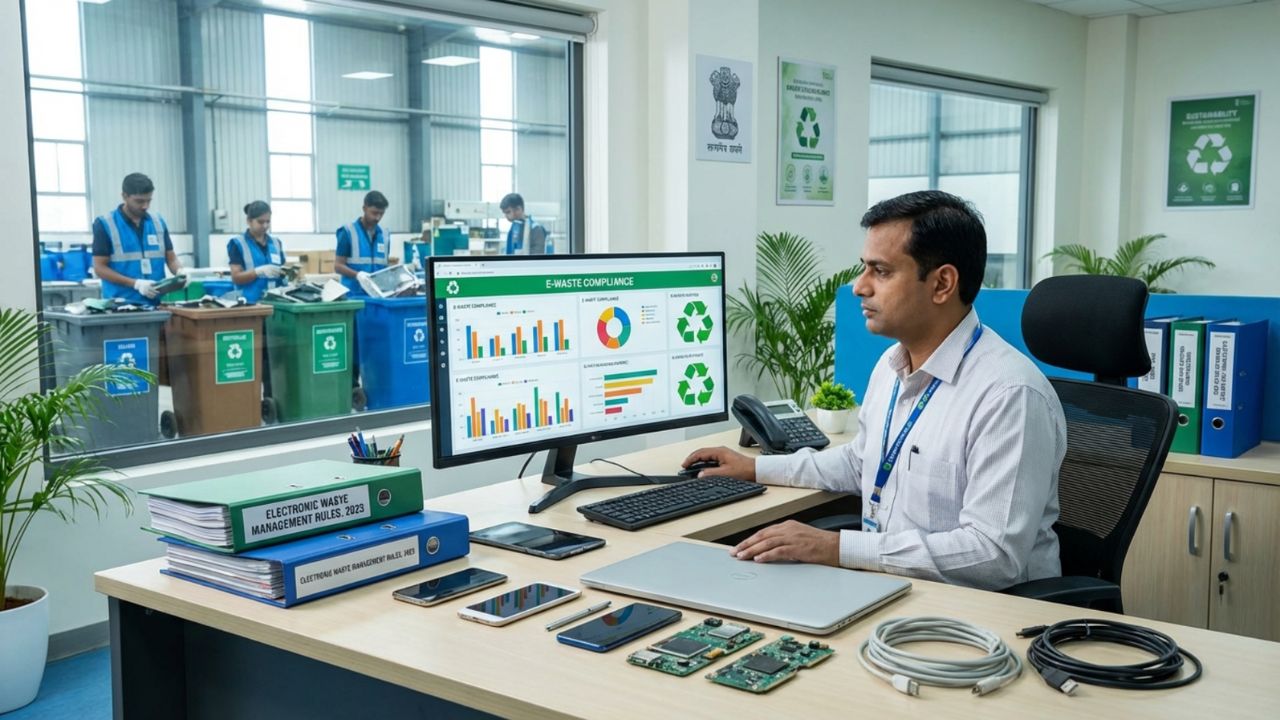
India’s growing dependence on electronic products has brought convenience, connectivity, and economic growth, but it has also created a major waste management challenge. Mobile phones, laptops, televisions, servers, household appliances, and other devices eventually reach the end of their useful life. When these products are discarded, they become electronic waste, or e-waste, which requires specialized handling because it contains both recoverable materials and hazardous substances.
To regulate this sector, India notified the E-Waste (Management) Rules, 2022 on November 2, 2022, and these rules came into force from April 1, 2023. The rules established a stronger digital compliance framework based on Extended Producer Responsibility (EPR), under which producers remain responsible for ensuring that e-waste arising from their products is properly recycled.

At the center of this framework is the Central Pollution Control Board (CPCB). CPCB plays the leading regulatory and monitoring role in the country’s e-waste system. It issues registrations to key stakeholders, operates the EPR portal, prepares guidelines and standard operating procedures, monitors compliance, coordinates with state authorities, and supports enforcement where violations occur.
Table of Contents
Why CPCB Matters in the E-Waste System
The e-waste framework in India involves multiple participants, including producers, manufacturers, recyclers, refurbishers, and state-level authorities. Without a central coordinating institution, it would be difficult to maintain consistency in registration, data reporting, target tracking, and verification.
CPCB provides that central structure. It functions as the national-level body that connects policy implementation with digital compliance systems. Instead of leaving e-waste management entirely to fragmented local processes, CPCB creates uniform rules, documentation standards, and operating procedures that apply across the country.

This central role is especially important because e-waste often moves across state boundaries. A recycler may collect waste from one region, process it in another state, and transfer unrecycled fractions to another authorized facility. CPCB’s oversight helps maintain a traceable and nationally coordinated compliance system.
CPCB as the Authority for Registration
One of CPCB’s most important roles is to issue registration under the e-waste rules. According to CPCB’s official FAQ, registration under the E-Waste (Management) Rules, 2022 is issued by CPCB to producers, recyclers, refurbishers, and manufacturers of electrical and electronic equipment listed in Schedule I of the rules. CPCB also clarifies that only these entities are required to register on the EPR portal, while dismantlers and bulk consumers do not register on the portal under Rule 4 in the same way.
This registration function is not a minor administrative step. It is what brings an entity into the formal compliance system. Once registered, the stakeholder can participate lawfully in activities such as placing covered products in the market, generating EPR certificates, or carrying out authorized recycling or refurbishment operations.

CPCB also publishes category-specific standard operating procedures for registration. These SOPs help applicants understand what information must be submitted, which documents are needed, and how scrutiny is handled. That makes CPCB not only the registering authority, but also the body that standardizes how registration is granted.
CPCB and the EPR Portal
CPCB is also responsible for operating the digital backbone of India’s e-waste compliance system. The portal is the place where registrations, obligations, transactions, and certificates are managed. Recent official amendments specifically assign CPCB the responsibility to ensure the operation and maintenance of the portal and the monitoring of EPR compliance through it.
This portal-based system changed the way e-waste compliance is handled. Instead of depending mainly on paper submissions and isolated records, the e-waste framework now uses a centralized digital mechanism. Producers, recyclers, and refurbishers interact with the system through online records, and CPCB uses the same platform to monitor registration status, obligations, and transactions.
Because CPCB controls this portal-based framework, it becomes the main institution ensuring that compliance data is captured in a consistent and traceable way. In practical terms, the Board is not just supervising e-waste policy from a distance. It is embedded in the actual digital workflow that supports registrations, certificate generation, and reporting.
CPCB’s Role in EPR Certificate Generation and Tracking
The EPR system depends on measurable compliance. Producers must fulfill annual obligations, and those obligations are met through the purchase of EPR certificates generated in favor of registered recyclers. CPCB’s guidance document explains that the Board generates these certificates through the portal based on the quantity of e-waste recycled by registered recyclers.
This means CPCB is not only setting the framework but also validating the digital instrument that producers use to prove compliance. Recyclers upload procurement details, recycling data, and records related to end products. CPCB then uses this information within the portal framework to support EPR certificate generation.
That role is highly important because certificate-based systems can only function well if the issuing authority is credible and able to verify the basis of the claim. CPCB provides that credibility by linking certificate generation to the regulated portal and to formal registration requirements.
Preparation of Guidelines and Standard Operating Procedures
CPCB’s role also includes preparing guidance documents and standard operating procedures. Recent official provisions explicitly state that CPCB shall prepare and issue guidelines and SOPs for portal registration, EPR certificates, refurbishing certificates, and related implementation matters.
This function matters because e-waste compliance is technical. Producers need clarity on how targets are fulfilled. Recyclers need instructions on what information must be uploaded and how procurement and processing records must be maintained. Refurbishers and manufacturers also need specific directions tailored to their category.
Through FAQs, SOPs, and guidance documents, CPCB translates the legal rules into operational procedures. This reduces uncertainty for regulated entities and improves consistency in implementation. It also supports better compliance because businesses are more likely to follow the rules correctly when the process is clearly described.
Monitoring, Verification, and Audit
A major part of CPCB’s role is ongoing monitoring. The e-waste system is not limited to one-time registration. It depends on repeated reporting, portal records, and cross-verification of data entered by different stakeholders.
CPCB’s guidance notes that EPR certificates generated through the portal are subject to environmental audit by CPCB or agencies authorized by CPCB. The same guidance also explains that State Pollution Control Boards and Pollution Control Committees periodically verify recycler facilities, machinery, capacity, invoices, and information uploaded on the portal. CPCB thus sits at the center of a layered monitoring structure that combines digital records with field-level checks.
This monitoring role is essential for preventing inflated recycling claims or unsupported transactions. By requiring uploaded records and supporting verification, CPCB helps make the system more credible and more transparent.
Coordination With State Pollution Control Boards
Although CPCB is the central authority, it does not work alone. E-waste enforcement and verification also involve State Pollution Control Boards (SPCBs) and Pollution Control Committees (PCCs). Official provisions now expressly state that CPCB must ensure coordination with SPCBs.
This coordination matters because many operational permissions, such as consent and authorization conditions, are handled at the state level. Recyclers and refurbishers, for example, depend on approvals from the concerned state authorities under pollution control and hazardous waste frameworks, while CPCB manages registration and central portal oversight.
In effect, CPCB acts as the national anchor, while SPCBs and PCCs provide regional enforcement and facility-level monitoring. The system works best when both levels remain aligned.
CPCB’s Role in Environmental Compensation and Enforcement
No compliance framework is complete without consequences for violations. The e-waste rules include provisions for environmental compensation in case of breaches. CPCB’s official FAQ notes that the rules include provision for imposition and collection of environmental compensation in case of violations, and later official amendments further state that CPCB shall lay down guidelines for imposition and collection of such compensation.
This gives CPCB a strong enforcement dimension. Its role is not limited to helping entities register or understand the process. It also supports action when stakeholders fail to comply with the rules, portal requirements, or related guidelines.
That enforcement function strengthens the seriousness of the e-waste regime. When businesses know that the system includes measurable obligations, monitoring tools, and the possibility of compensation-based penalties, compliance becomes harder to ignore.
Summary of CPCB’s Main Functions
| CPCB Function | What It Involves |
|---|---|
| Registration authority | Issues registration to producers, recyclers, refurbishers, and manufacturers |
| Portal operation | Maintains the EPR portal and monitors digital compliance |
| Certificate oversight | Generates and supports tracking of EPR certificates through the portal |
| SOPs and guidelines | Issues operational instructions for registration and compliance |
| Monitoring and audit | Supports audits, cross-verification, and record review |
| Coordination | Works with SPCBs and PCCs for implementation and checks |
| Enforcement support | Frames environmental compensation guidelines and compliance controls |